 GET QUOTE
 NEWSLETTER
 LOGIN
LOGIN

LASER CLASSES FOR FIBER LASERS: Safety and regulations
BY GEERT PAS, TEAM LEADER HEALTH, SAFETY & ENVIRONMENT AT VOORTMAN
Modern fiber lasers are more powerful and efficient than ever before. Because their beams are invisible to the naked eye, clear safety standards are needed. This is where laser classes come in.
In industrial environments like steel fabrication or plate processing, fiber lasers can reach extremely high power levels. These beams are strong enough to cut through metal within seconds. Therefore, they need to be controlled, enclosed and used with the right safety measures in place.
Laser classes help manufacturers, operators and companies understand how “accessible” a laser system is. They also indicate what level of protection is required. Laser classes make it clear when a machine is safe to use from the outside. They also indicate when the powerful laser beam inside would be dangerous if exposed.
By understanding these classes, it becomes much easier to see why CNC laser cutting machines are designed the way they are. It also shows how they keep operators safe, even while housing incredibly powerful fiber laser sources. And if you're considering investing in a laser machine, knowing the different classes helps you choose the right system.
In this article:


What is a fiber laser?
Before we dive into laser classes, it’s helpful to understand how a fiber laser works. Laser is an abbreviation for Light Amplification by the Stimulated Emission of Radiation. A source (solid state) transports light through a fiber cable to reach the necessary energy level. Then a high-intensity, tightly focused beam is formed.
This beam provides the power and precision to cut through materials such as steel. This industrial type of laser is used for demanding applications in manufacturing, like steel processing.
If you want to know more about how high power fiber lasers work, we’ve written a full article:
Why laser classes exists
Laser classes exist to ensure that everyone working with laser can do so safely and responsibly. The classification system is established by the International Electrotechnical Commission (IEC) in the standard IEC 60825‑1. These international standards group lasers into different classes. Each class reflects the laser’s power, the risks it may pose, and the safety measures needed during operation. This system provides clarity for both manufacturers and users. It helps them understand the hazards and define the right safety approach.
Laser classes chart
Laser classes 1 & 4
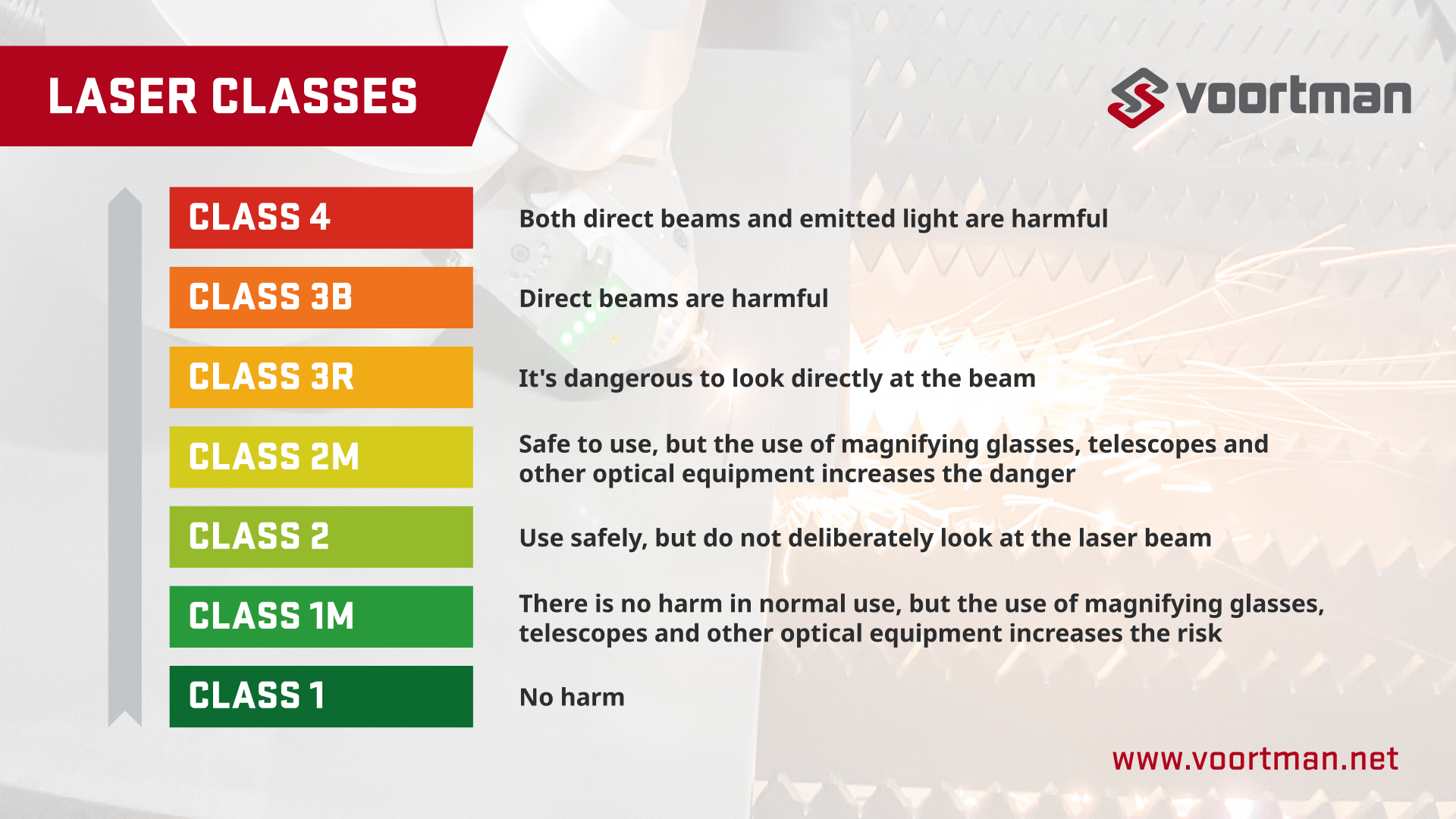
The IEC 60825‑1 standard defines several laser classes. In industrial steel processing, you will typically encounter two of these laser classes, Class 1 and Class 4 systems. Here’s what these two classes mean in practice:
Laser class 1 machine
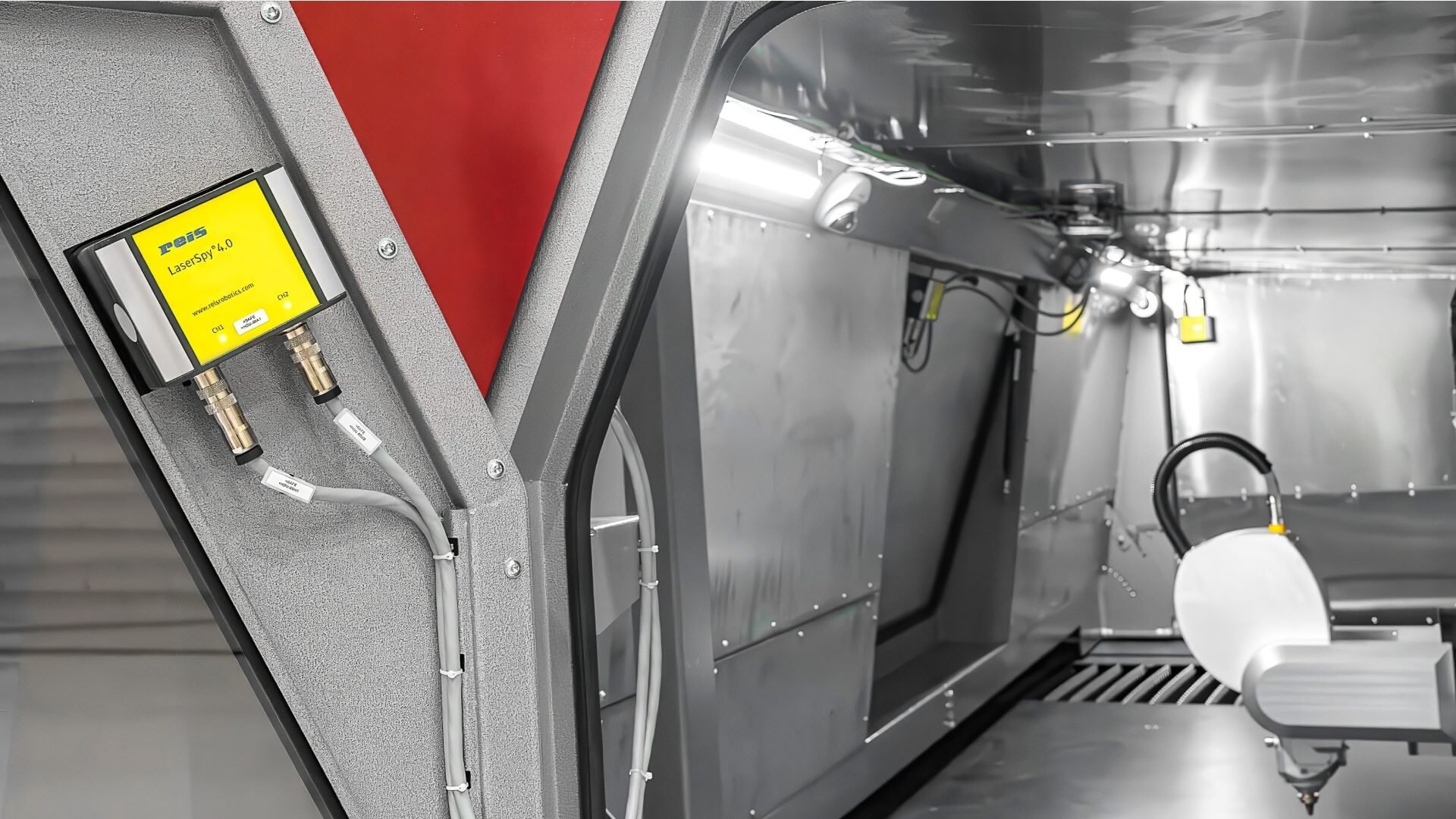
Class 1 lasers are the safest kind to be around. With a class 1 laser, the laser light is completely locked away inside a machine or working area. You’ll find these in fully enclosed systems, such as our own Voortman laser cutting machines. The laser inside can be very powerful. However, the enclosure is designed to contain both the direct laser beam and any residual radiation caused by reflection or scattering. During normal operation, the machine is used as intended and all covers and interlocks remain intact. This ensures that no hazardous laser radiation can escape the machine housing. You’re fully protected. Operators do not need special laser goggles or protective clothing just to stand near a laser class 1 machine.
Good to know: The laser beam is the focused, high‑intensity light used for cutting and can cause serious injury if directly viewed. Laser radiation is a broader term that also includes reflected and scattered light inside the machine. It is harmless if kept below limits.
Laser class 4 machine
Class 4 lasers are the most dangerous. A high‑power laser cutting system must be fully enclosed to ensure safety. If the enclosure has gaps, holes, or faulty curtains, it must be treated as a Class 4 laser. These lasers can cause severe eye- and skin injury from direct or reflected exposure. A Class 4 laser system can also emit residual radiation outside the immediate beam path. That includes: reflected laser light, scattered laser radiation and indirect exposure from nearby surfaces. They can also ignite materials. Operating Class 4 lasers requires strict precautions. This includes certified laser safety eyewear, protective clothing, controlled work areas and suitable shielding.
Remember this: Class 1 means the machine keeps you safe, and Class 4 means you must actively keep yourself safe.
Laser systems are incredibly powerful tools in industrial steel processing. They must be handled with care and in accordance with the safety rules of their laser class.
The laser class of your machine
Are you unsure about the laser class of your machine? The quickest way to check is by looking for the yellow laser safety label on the equipment. This label must show the class according to IEC 60825‑1. It tells you immediately whether the system is a safe, enclosed Class 1 machine or a high‑risk Class 4 laser. You can also find the classification in the machine’s manual or technical documentation. If the information isn’t easily accessible, you can ask the manufacturer or supplier.
It’s important to remember that a machine only remains Class 1 if its enclosure is fully intact. Gaps, damaged curtains or bypassed safety systems effectively turn it into a Class 4 laser. When there is any uncertainty or a safety feature appears incorrect, treat the system as high risk. Confirm the laser classification before proceeding.
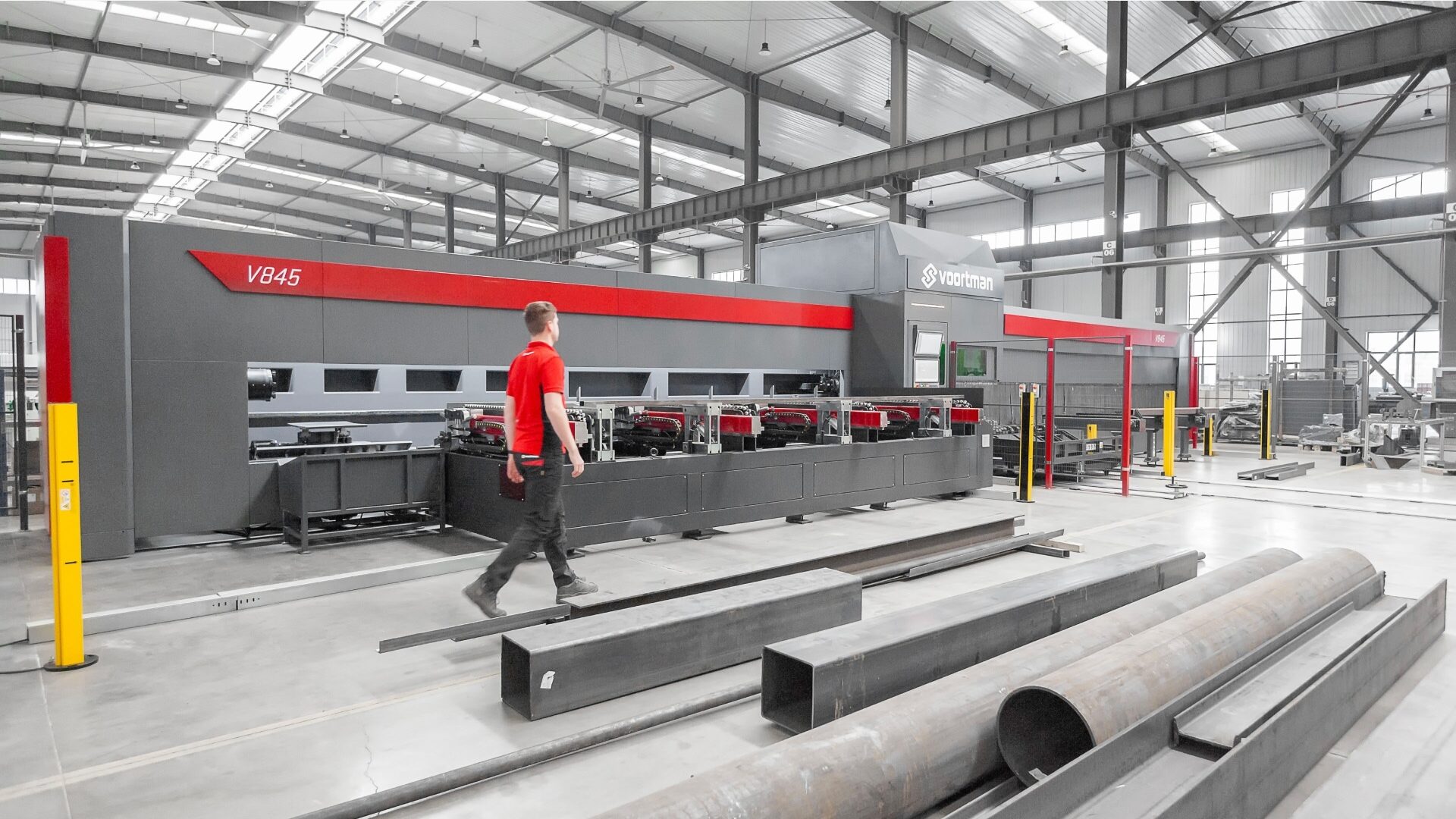
Voortman laser machines are always Class 1 during normal operation. Our machines are fully enclosed. This design prevents operator exposure to the laser beam and any residual laser radiation during normal operation.
What makes a fiber laser potentially dangerous?
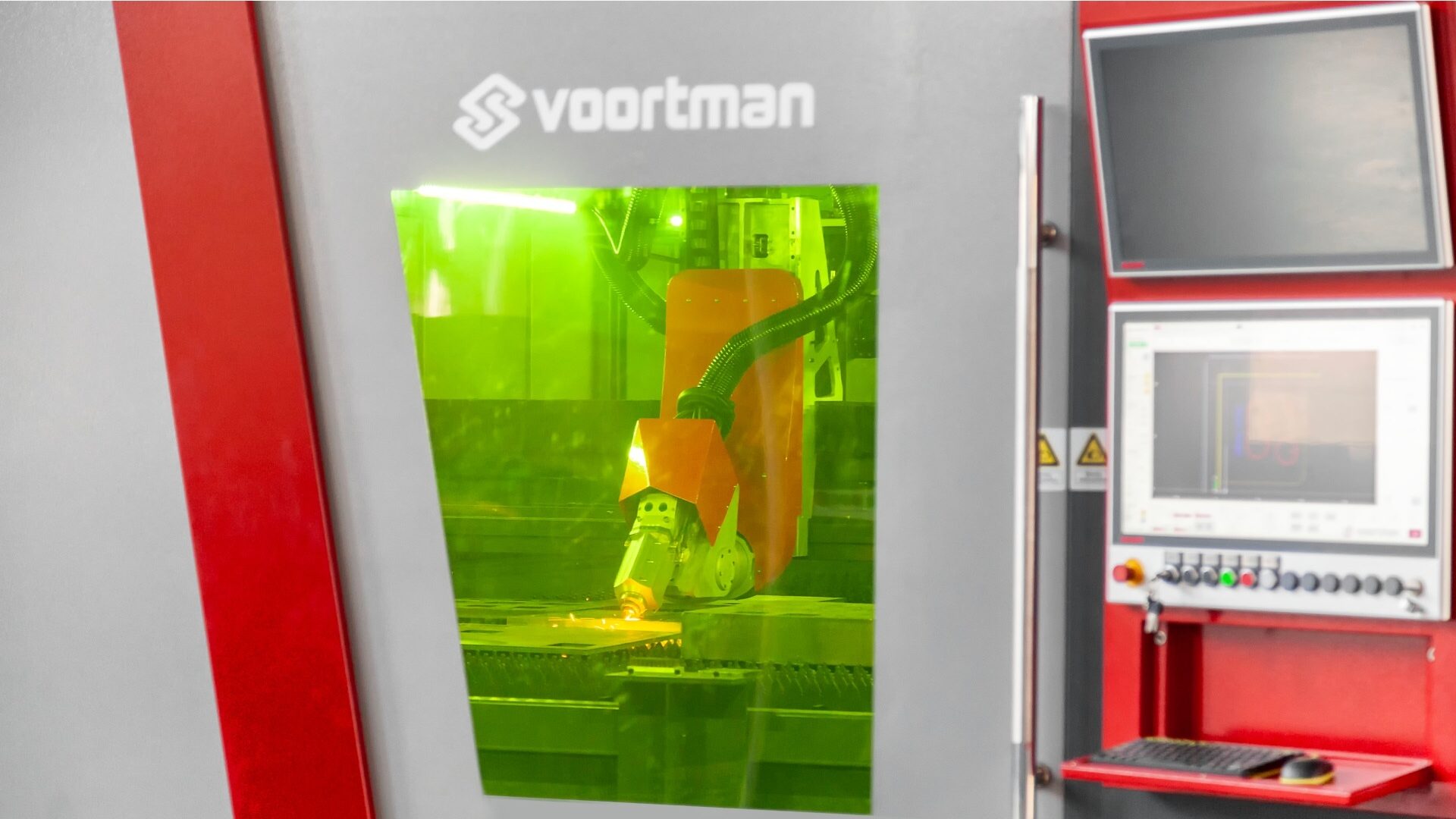
A fiber laser beam is completely invisible. It cannot be felt. Therefore, the eye’s natural blink reflex never activates if a (reflected) laser beam enters the eye. The danger is that the eye still absorbs the laser’s energy. This can permanently damage the retina before a person even realizes anything is wrong. (The retina is the light‑sensitive layer at the back of your eye. It works a bit like the sensor in a camera.) This risk exists with Class 4 lasers, where the beam or reflections are not contained.
Why are fiber laser beams invisible? Most industrial fiber lasers operate at around 1070 nanometer (nm). In other words: the light of the laser has a wavelength of 1070 nm. Humans can typically see light with wavelengths from about 380 nm to 700 nm. Because the wavelength of fiber laser light is outside the visible range, the beam is completely invisible.
Skin can also be harmed by a fiber laser, but the risk works differently. If laser light or a reflection of it touches skin, it heats the skin up. Because skin has pain receptors, you usually feel the heat quickly and pull away, which helps limit the damage.
Understanding the risks of fiber laser beams provides important context. With this knowledge, laser classes become easier to grasp.
CE Markings and laser safety
Laser classes show how much laser radiation a machine can expose operators to, but compliance doesn’t stop there. Every laser system sold in Europe must also meet the broader safety requirements of the applicable EU machinery legislation. That’s where CE marking comes in.
The key point is that the manufacturer or importer is legally responsible for making sure the machine is safe. To prove this, they must follow a formal process before placing a CE mark on the machine. This process starts by identifying all possible risks. These risks are documented in a technical file, followed by measures to reduce them. Finally, it demonstrates that the machine meets essential safety requirements, often by applying European safety standards.
The manufacturer must also write a Declaration of Conformity. This shows that the machine is safe and meets EU rules. In addition, the manufacturer must also provide a user manual in the local language. Only when all these steps are completed is the CE mark allowed.
Be aware of incorrect or misleading CE markings
Some machines have a CE marking even though they do not fully meet EU safety requirements. In some cases, manufacturers themselves apply a CE mark that is incorrect, incomplete or misleading. A CE logo on its own does not guarantee that a machine meets all EU requirements.
In practice, it can be difficult to see the difference between a correct CE marking and an incorrect or misleading one. As a result, non‑compliant machines may appear compliant at first sight.
When assessing a machine, buyers can take the following steps:
- Always verify whether the CE mark is accompanied by proper documentation, such as the EU Declaration of Conformity.
- Check whether the machine complies with the relevant standards and directives.
- When in doubt, ask the manufacturer for detailed evidence of compliance.
The CE mark should represent safety and quality. It has value when it’s backed up by real compliance.
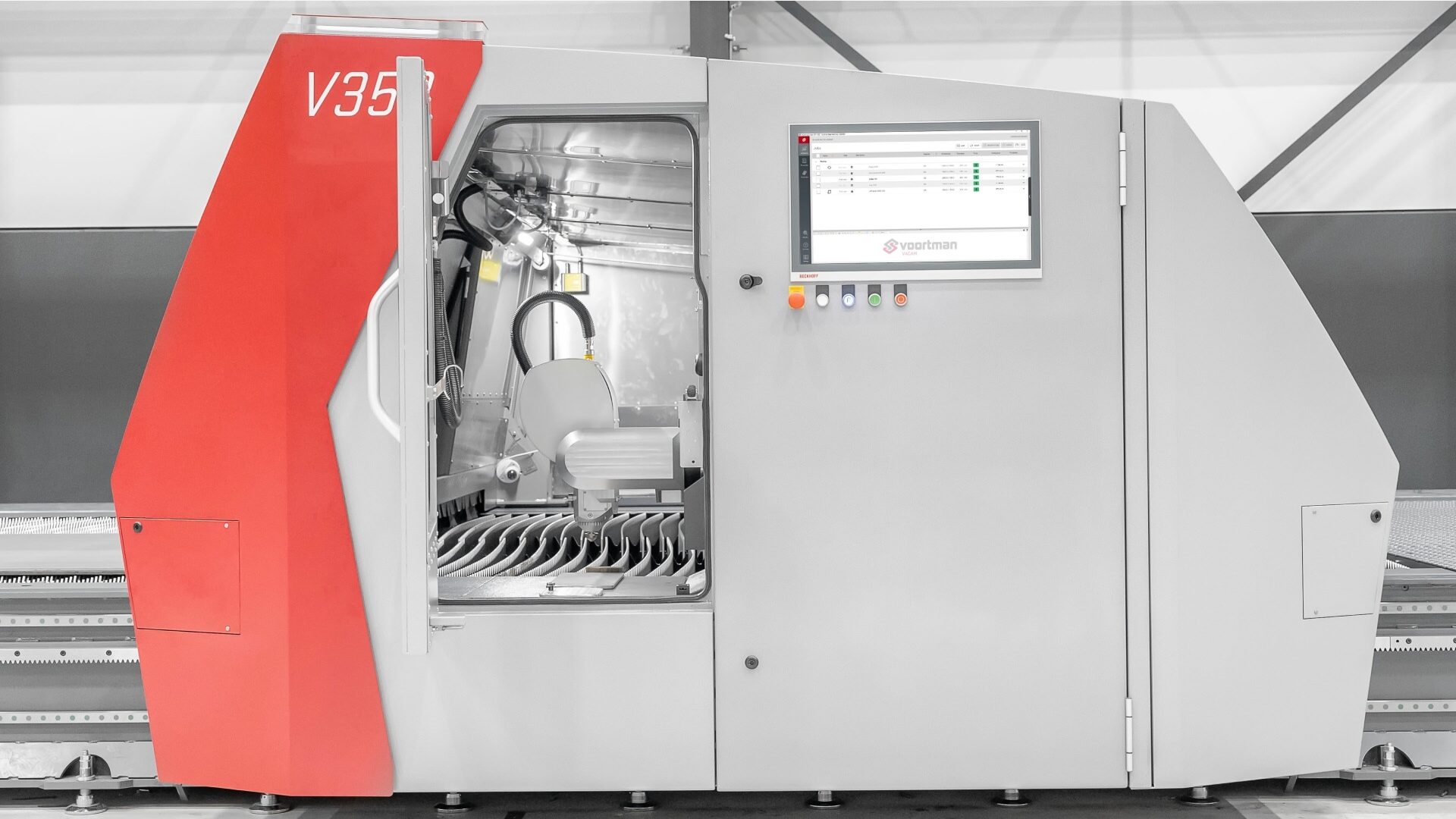
Voortman machines are laser class 1
All Voortman machines that use laser technology, are classified as Laser Class 1. They are all designed so that operators are never exposed to hazardous laser radiation during normal operation. Here’s how:
- The laser is fully enclosed
- No harmful radiation can escape
- Safety interlocks prevent exposure
- Certified shielding protects operators
- They comply with strict international standards